- English
- French
- German
- Portuguese
- Spanish
- Russian
- Japanese
- Korean
- Arabic
- Irish
- Greek
- Turkish
- Italian
- Danish
- Romanian
- Indonesian
- Czech
- Afrikaans
- Swedish
- Polish
- Basque
- Catalan
- Esperanto
- Hindi
- Lao
- Albanian
- Amharic
- Armenian
- Azerbaijani
- Belarusian
- Bengali
- Bosnian
- Bulgarian
- Cebuano
- Chichewa
- Corsican
- Croatian
- Dutch
- Estonian
- Filipino
- Finnish
- Frisian
- Galician
- Georgian
- Gujarati
- Haitian
- Hausa
- Hawaiian
- Hebrew
- Hmong
- Hungarian
- Icelandic
- Igbo
- Javanese
- Kannada
- Kazakh
- Khmer
- Kurdish
- Kyrgyz
- Latin
- Latvian
- Lithuanian
- Luxembou..
- Macedonian
- Malagasy
- Malay
- Malayalam
- Maltese
- Maori
- Marathi
- Mongolian
- Burmese
- Nepali
- Norwegian
- Pashto
- Persian
- Punjabi
- Serbian
- Sesotho
- Sinhala
- Slovak
- Slovenian
- Somali
- Samoan
- Scots Gaelic
- Shona
- Sindhi
- Sundanese
- Swahili
- Tajik
- Tamil
- Telugu
- Thai
- Ukrainian
- Urdu
- Uzbek
- Vietnamese
- Welsh
- Xhosa
- Yiddish
- Yoruba
- Zulu
AG Panel Roll Forming Machine: Complete Buyer’s Guide 2026
When you're searching for reliable metal panel fabrication solutions, an AG panel roll forming machine emerges as the industry-standard cold-forming system engineered to produce agricultural profile roofing and siding from galvanized or pre-painted steel coils. This specialized equipment addresses critical manufacturing challenges, including precision rib formation, anti-siphon groove accuracy, and material yield optimization—delivering consistent 36-inch coverage panels with 3/4-inch major ribs at 9-inch centers. Throughout this comprehensive guide, we'll walk you through everything procurement professionals need to know about selecting, operating, and maintaining these essential production line assets.
Understanding AG Panel Roll Forming Machines
An AG panel roll forming machine is a highly precise piece of industrial machinery that is designed to turn flat metal coils into rigid panels that are used in light commercial, residential, and agricultural construction. Unlike other sheet metal machines, these ones have special roller configurations that shape the metal slowly as it goes through several forming stations without damaging the coating or the machine's structural integrity.
Core Components and Operational Workflow
A typical production line is made up of several connected systems that work perfectly together. The decoiler feeds raw material into the entry guide system. This keeps the tension and alignment constant. The raw material is usually 29-gauge to 26-gauge galvanized steel or Galvalume. The material is then put through 16 to 22 progressive forming stations, each with high-quality Cr12MoV steel rollers that have been heated, chrome-plated, and shaped to a thickness of 0.05 mm. This slow shaping method keeps the material from getting stressed and makes the unique AG profile with its weathertight side-lap channels and anti-siphon grooves that stop water from getting in through tiny holes in the surface.
Technical Specifications That Matter
Modern machines move at speeds of 30 to 60 meters per minute and are controlled by high-tech PLC systems made by companies like Siemens and Mitsubishi. These controllers have built-in encoder feedback systems that make sure the length tolerance is within ±1.0mm. This is important for cutting down on waste during installation. The drive system uses heavy-duty chain transmission or gearbox configurations that are mounted on an H-beam chassis. These keep the profile consistent even when working with G550 or Grade 80 high-tensile materials by reducing vibration.
Panel-forming machines made for agricultural profiles can work with material thicknesses ranging from 0.35 mm to 0.8 mm without needing to be adjusted by hand. However, if the gauge changes a lot, small gap adjustments may be needed. The hydraulic cutting station has synchronized shearing blades that make clean cuts without deforming the edges of the panels. This is important for keeping the weatherproofing integrity at the end laps.
Automation Levels and Customization Options
There are three types of automation equipment that are available. Manual models need an operator to help with measuring length and making cutting decisions. These models are good for new businesses that don't have a lot of money to invest. Programmable length controls and automatic cutting cycles are built into semi-automatic models, but materials still need to be loaded by hand. Fully automated lines have quality inspection sensors that find flaws in the surface or changes in dimensions in real time, robotic stacking systems, and automatic coil changeover mechanisms.
Customization goes beyond the level of automation. For example, with an AG panel roll forming machine, companies make roller cassettes that can be switched out so that the profile can be changed between standard AG, R-panel, or PBR configurations. Some high-tech systems have double-layer designs that let two different profiles share a single footprint. This solves the problem that the industry faces when it comes to high capital costs and limited floor space.

Procuring Your AG Panel Roll Forming Machine
To get things done, you need to know about cost structures, financing options, and supplier evaluation criteria that protect your company's long-term manufacturing interests. Purchasing an AG panel roll forming machine is a significant investment that requires careful planning.
Investment Cost Factors and Price Ranges
The price of equipment depends on a number of factors that go beyond the level of basic automation. The number of forming stations affects both the machine's capabilities and its cost. Machines with 16 to 18 stations are good for standard profiles, while machines with 20 to 22 stations can handle complex geometries or thicker gauges with fewer spring-back problems. The type of material used for rollers has a big impact on how long they last. Cheap models are made of 45# steel, which has a hardness rating of 58–60 HRC. More expensive models are made of Cr12MoV steel, which has a hardness rating of 60–62 HRC and increases the time between sharpenings from 6–8 months to 12–15 months.
Customization requests like needing profile-specific tools, roller surfaces that are compatible with certain coatings, or quality inspection systems that are built in for the AG panel roll forming machine raise the cost. A basic semi-automatic system could cost as little as $48,000. However, if you want full customization like dual-profile support, servo cutting systems, and automated stacking, the total cost will rise to $95,000 to $110,000.
Financing and Bulk Procurement Strategies
As more manufacturers realize that buying capital equipment can be hard on an organization's cash flow, they are offering more flexible payment terms. A common structure is a 30% deposit, 60% upon completion of production and factory inspection, and 10% retention after installation and operator training go well. Leasing deals through third-party finance partners are an alternative, especially for startups that don't have a lot of cash on hand but have a lot of orders coming in.
Buyers in large quantities, like franchise metal building suppliers or international distributors, can negotiate better prices, longer warranties, and faster access to spare parts. When you buy multiple machines in a package deal with shared tooling inventories, you usually save 12 to 18% on the cost of each machine bought separately.
New Equipment Versus Certified Pre-Owned Options
Buyers on a budget can consider buying certified pre-owned machines as an alternative. Reputable manufacturers fix up used or returned equipment by replacing worn parts, updating control systems, and making sure that mechanical tolerances are back to the original standards. These units usually cost between 40 and 55 percent of the price of brand-new equipment, and they come with limited warranties that cover major parts for 12 to 24 months. But buyers should make sure about the scope of the refurbishment, the technical documentation that is available, and the ongoing availability of parts before making a decision.
When you buy new equipment, you get access to the newest efficiency technologies, full manufacturer warranties that last between 12 and 36 months, depending on the type of part, and the freedom to make changes that fit your production needs. The schedule for depreciation encourages manufacturers to buy new equipment with a lifecycle of 10 to 15 years because the extra cost is spread out over a lot more production.
Factory-Direct Purchasing and Lead Time Considerations
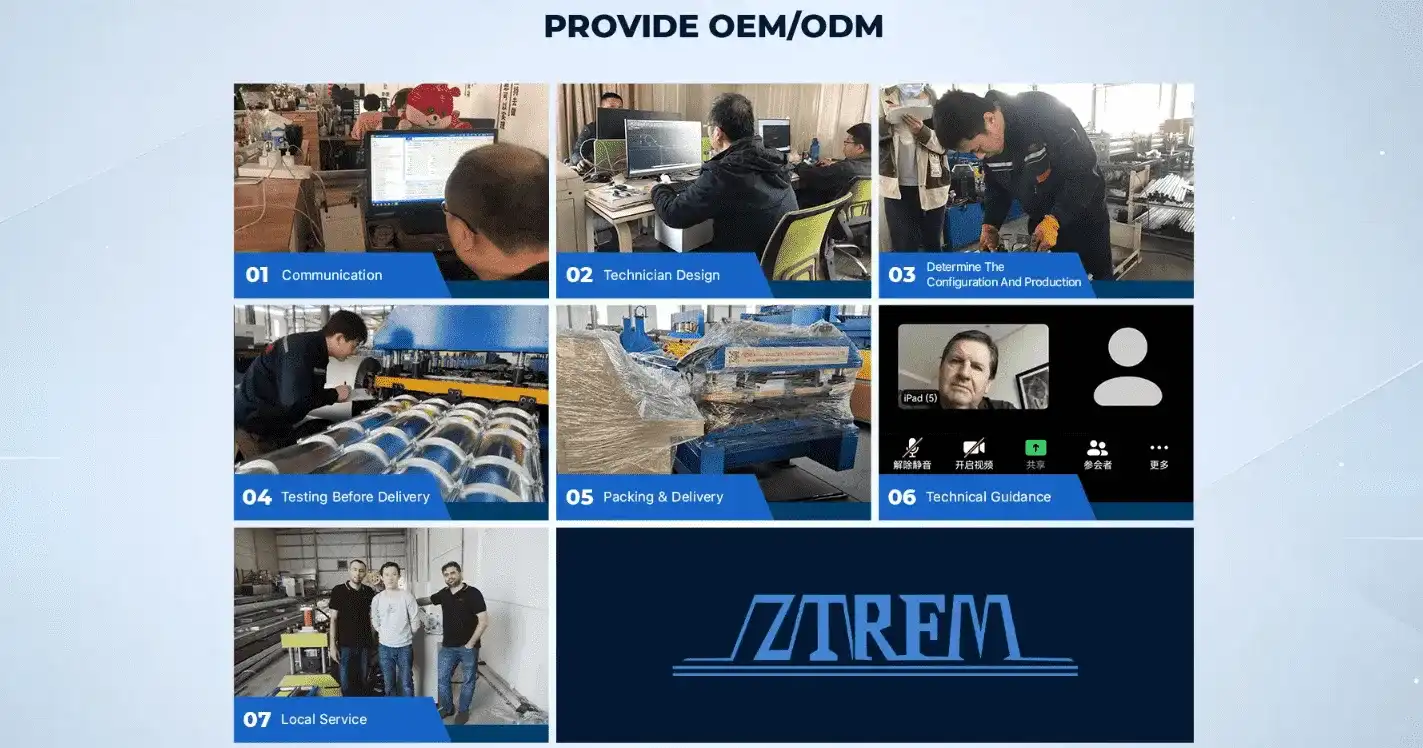
When you work directly with a manufacturer, you avoid the 15–25% markups that distributors add, and you can get engineering help when you're making specifications. Established companies like ZTRFM, which is certified by ISO9001 and CE and has delivered machines to more than 150 countries, offer complete solutions that include providing machines, supervising their installation, and training operators. This unified method makes project coordination easier and makes sure that all system parts work together.
Standard equipment production for the AG panel roll forming machine takes 45 to 60 days after receiving a deposit. Custom configurations, on the other hand, may take 75 to 90 days, depending on how complicated the tooling is. Buyers should make sure that lead times work with their plans for preparing the facility, upgrading the electrical infrastructure, and training the workforce so that there aren't any costly production delays or periods when equipment isn't being used.

Operational Guide and Maintenance Best Practices
To get the most out of your equipment investment, you need to follow strict operational guidelines and do regular preventative maintenance. This will extend the useful life of your AG panel roll forming machine and cut down on unplanned downtime.
Initial Setup and Safety Protocols
Preparing the foundation is the first step in a proper installation. The concrete pads must cure completely and meet level tolerances within 0.5 mm per meter to avoid problems with frame stress and misalignment. Electrical connections need to be checked against the manufacturer's specifications. For reliable motor performance and PLC operation, three-phase power supply stability is especially important. To keep sensitive electronic parts safe from voltage changes, grounding systems must meet local electrical codes.
As part of safety rules, machines must have guards around pinch points, emergency stop buttons must be placed every 15 feet along production lines, and lockout-tagout procedures must be followed for maintenance work. When training operators, they should focus on the right way to handle materials, especially when loading heavy coils onto decoilers. They should also set clear rules for how to talk to each other when more than one person is working on the same line.
Daily, Weekly, and Monthly Maintenance Checklists
Every day, maintenance is mostly done by doing quick checks that take 15 to 20 minutes before starting up production. Operators should check the alignment of the rollers by running sample panels and comparing the profile dimensions to the specifications. They should also check the level of hydraulic fluid and look for leaks around the cylinder seals, lubricate the chain drives based on the temperature of the room, and clear away any debris from the cutting blade areas that could stop the shearing action.
The number of procedures done each week grows to about 45 to 60 minutes of preventive care. This includes checking the rollers carefully for damage or buildup of coating, making sure the drive chain tension is correct and adjusting it if necessary, looking at the PLC error log to find recurring problems that need to be fixed, and checking the cutting blade edges to make sure they need to be sharpened before the quality of the finished panels shows signs of it.
Comprehensive maintenance should be done once a month, and it usually takes two people to do it right. Complete lubrication system service with new filters, checking and topping off the gearbox oil level, making sure the electrical connections are tight to avoid arcing or resistance heating, and precisely measuring critical roller gaps using feeler gauges to find wear patterns that show when replacements are needed.
Troubleshooting Common Production Issues
AG panel roll forming machine: Panel flat sections that ripple or oil-can often have problems caused by too much roller pressure or uneven coil tension. Resolution involves slowly lowering the forming pressure while keeping an eye on the quality of the output and changing the decoiler brake tension to keep the material feed steady. Dimensional differences along the length of a panel are usually caused by encoder calibration drift, which can be fixed by following the steps in the technical manuals for recalibration of the PLC.
Damage to the coating that looks like scratches or scuff marks could be caused by a dirty roller or not enough chrome plating thickness. Stopping production right away stops any more waste from happening. Operators should use approved solvents to clean the rollers well and look for plating wear that needs to be fixed by a professional. Cutting quality problems like ragged edges or incomplete shears are signs that the blade is dull. Most Cr12MoV blades need to be sharpened every 6 to 8 months when they are used to cut standard galvanized steel at normal production rates.
When an operator doesn't know how to fix a problem with an AG panel roll forming machine, manufacturers like ZTRFM offer remote technical support through video consultation, which often fixes problems without having to make an expensive service call. Complex mechanical problems may need to be fixed on-site, which shows how important it is to choose suppliers with well-established North American service networks that can respond within 48 to 72 hours.

Conclusion
In conclusion, selecting the right metal panel forming equipment involves carefully considering its technical capabilities, the dependability of its suppliers, and the total cost of ownership over the expected lifecycles of the equipment. To make AG profiles, you need special machines that can balance speed, accuracy, and durability. These features directly affect your ability to compete in construction markets that care a lot about price. We've looked at the main technologies that make modern roll forming systems unique, as well as buying strategies that will protect your investment, and ways to run your business that will make your equipment last longer. As you make decisions about equipment, give more weight to manufacturers that can show they have engineering expertise, a global support infrastructure, and a track record of performance in applications that match your production needs.
FAQ
1. What material gauges can standard equipment process?
Most AG panel-forming machines can work with steel gauges from 29 gauge to 26 gauge without any adjustments. This means they can be used in most agricultural and residential settings. When working with heavier 24-gauge material, the roller gap needs to be changed to accommodate the extra thickness. Processing aluminum is possible, but the pressure needs to be changed because aluminum substrates don't spring back the same way steel substrates do.
2. How often do hydraulic cutting systems require blade maintenance?
When working in standard eight-hour shifts on galvanized steel, Cr12MoV cutting blades usually need to be sharpened every six to eight months. Intervals may be cut down to 4 to 6 months with high-tensile Grade 80 materials or longer production schedules. After 3–4 reconditioning cycles, when material removal changes the shape of the blade, it needs to be replaced instead of being sharpened.
3. Can one machine produce multiple panel profiles?
Modern machines have roller cassettes that can be switched out so that the profile can be changed between AG, R-panel, and PBR configurations. Changeover takes between two and four hours, depending on how the system is set up and how experienced the operator is. Double-layer machines can work on two profiles at the same time, so there are no delays during changeovers. However, they cost more to buy at first.
Partner with ZTRFM for Your Metal Forming Solutions
ZTRFM is known as a reliable supplier of the AG panel roll forming machine because they consistently send high-quality machines that meet the strict needs of roofing system manufacturers, metal building contractors, and industrial fabricators all over North America. Our engineering team works directly with clients to come up with the best configurations, whether they need fast automation for mass production or adaptable manual systems for a wide range of products.
We do more than just sell equipment. We also offer full support, such as installation supervision, hands-on operator training programs, and quick technical support backed by our ISO9001 and CE certifications. Our global parts distribution network makes sure that important parts are always available, which lowers the risk of downtime that could delay production. Contact our team at zhongtuorollforming@gmail.com to talk about your specific panel production needs, get detailed technical specs, or set up a virtual demonstration of our newest energy-saving innovations. We want to help you choose roll forming solutions that will increase your productivity and add value to your business over time.
References
1. Metal Construction Association. (2025). Roll Forming Technology Standards and Best Practices for Agricultural Panel Production. Cleveland: MCA Technical Publications.
2. Johnson, R.T., & Chen, M. (2024). Cold-Forming Systems: Engineering Principles and Industrial Applications. New York: Industrial Press.
3. American Iron and Steel Institute. (2024). Galvanized Steel Sheet Product Manual: Specifications and Forming Guidelines. Washington: AISI Standards Division.
4. Peterson, L.K. (2025). Metal Building Component Manufacturing: Equipment Selection and Production Optimization. Chicago: Construction Technology Publishers.
5. International Code Council. (2024). Metal Roof Panel Installation Standards and Quality Requirements. Washington: ICC Building Standards.
6. Williams, D.A., & Martinez, J. (2025). Industrial Maintenance Protocols for Metal Forming Equipment. Boston: Manufacturing Technology Institute.
_1750323743240.webp)