- English
- French
- German
- Portuguese
- Spanish
- Russian
- Japanese
- Korean
- Arabic
- Irish
- Greek
- Turkish
- Italian
- Danish
- Romanian
- Indonesian
- Czech
- Afrikaans
- Swedish
- Polish
- Basque
- Catalan
- Esperanto
- Hindi
- Lao
- Albanian
- Amharic
- Armenian
- Azerbaijani
- Belarusian
- Bengali
- Bosnian
- Bulgarian
- Cebuano
- Chichewa
- Corsican
- Croatian
- Dutch
- Estonian
- Filipino
- Finnish
- Frisian
- Galician
- Georgian
- Gujarati
- Haitian
- Hausa
- Hawaiian
- Hebrew
- Hmong
- Hungarian
- Icelandic
- Igbo
- Javanese
- Kannada
- Kazakh
- Khmer
- Kurdish
- Kyrgyz
- Latin
- Latvian
- Lithuanian
- Luxembou..
- Macedonian
- Malagasy
- Malay
- Malayalam
- Maltese
- Maori
- Marathi
- Mongolian
- Burmese
- Nepali
- Norwegian
- Pashto
- Persian
- Punjabi
- Serbian
- Sesotho
- Sinhala
- Slovak
- Slovenian
- Somali
- Samoan
- Scots Gaelic
- Shona
- Sindhi
- Sundanese
- Swahili
- Tajik
- Tamil
- Telugu
- Thai
- Ukrainian
- Urdu
- Uzbek
- Vietnamese
- Welsh
- Xhosa
- Yiddish
- Yoruba
- Zulu
How Custom Profile Roll Forming Machines Enable Unique Metal Wall Panel Designs?
In the ever-evolving world of architecture and construction, the demand for innovative and visually striking building facades continues to grow. Custom profile roll forming machines have emerged as a game-changing technology, empowering architects and designers to push the boundaries of creativity in metal wall panel designs. This article delves into the fascinating realm of custom profile roll forming and explores how these machines are revolutionizing the way we approach architectural metal panel production.
How do custom profile roll forming machines create virtually endless metal wall panel variations?
Custom profile roll forming machines are sophisticated pieces of equipment that have transformed the metal fabrication industry. These machines utilize a series of precisely engineered rollers to gradually shape flat metal coils into complex, three-dimensional profiles. The beauty of custom profile roll forming lies in its ability to produce an astonishing array of panel designs, limited only by the imagination of the designer and the capabilities of the machine.
The process begins with a flat metal coil, typically made of materials such as steel, aluminum, or copper. As the metal sheet passes through the roll forming machine, it encounters a sequence of roller dies, each carefully designed to impart a specific bend or contour to the material. These rollers work in concert to progressively shape the metal into the desired profile, creating intricate geometries, textures, and patterns along the way.
What sets custom profile roll forming machines apart is their unparalleled flexibility. Unlike traditional roll forming equipment that produces standard, off-the-shelf profiles, custom machines can be configured to create bespoke designs tailored to specific architectural visions. This adaptability allows for the production of unique panel shapes, including:
- Undulating waves and curves
- Sharp angles and zigzag patterns
- Perforated and embossed surfaces
- Interlocking and modular panel systems
- Three-dimensional textures and reliefs
The versatility of custom profile roll forming extends beyond mere aesthetics. These machines can also incorporate functional features into panel designs, such as integrated rainscreen systems, thermal breaks, and hidden fastening mechanisms. This fusion of form and function results in wall panels that not only captivate the eye but also contribute to the overall performance and efficiency of the building envelope.

Design Flexibility — Custom Tooling, Quick Changeovers & Profile Libraries
The true power of custom profile roll forming machines lies in their ability to adapt swiftly to changing design requirements. This flexibility is achieved through a combination of innovative features and technologies:
Custom Tooling
At the heart of every custom profile roll forming machine is its tooling system. These precision-engineered components are responsible for shaping the metal into the desired profile. Custom tooling allows manufacturers to create unique roller configurations that can produce virtually any panel design imaginable. Advanced computer-aided design (CAD) and computer-aided manufacturing (CAM) technologies have streamlined the tooling development process, enabling rapid prototyping and iteration of new panel profiles.
Quick Changeovers
Modern custom profile roll forming machines are designed with efficiency in mind. Quick-change tooling systems allow operators to switch between different panel profiles in a matter of minutes, rather than hours. This agility is crucial in today's fast-paced construction industry, where project timelines are often tight, and design changes can occur late in the process. The ability to quickly retool the machine means manufacturers can respond to last-minute design modifications without significant delays or additional costs.
Profile Libraries
Leading manufacturers of custom profile roll forming equipment have developed extensive libraries of pre-engineered panel profiles. These libraries serve as a valuable resource for architects and designers, offering a wide range of proven designs that can be quickly implemented or used as starting points for further customization. Profile libraries not only streamline the design process but also provide assurance that the selected panel design has been tested and validated for performance and manufacturability.
The combination of custom tooling, quick changeovers, and profile libraries creates an environment of unprecedented design freedom. Architects can explore multiple panel variations, experiment with different textures and patterns, and refine their designs iteratively without incurring prohibitive costs or delays. This level of flexibility allows for the creation of truly unique building facades that stand out in the urban landscape and reflect the individual character of each project.
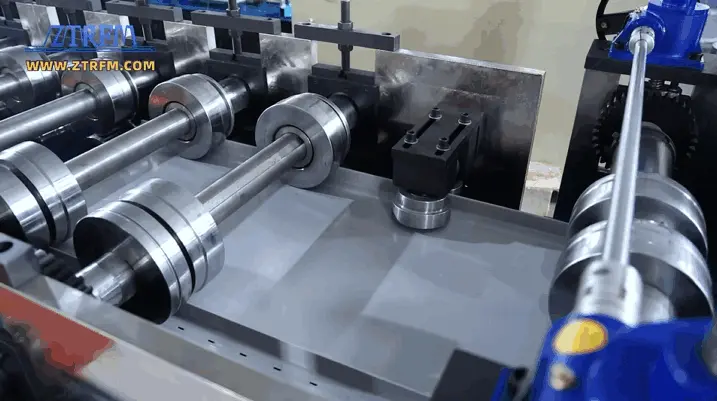
What production and performance advantages let custom roll formers meet architectural specs?
Custom profile roll forming machines offer numerous production and performance advantages that enable manufacturers to meet even the most demanding architectural specifications:
High-Speed Continuous Production
One of the primary benefits of roll forming is its ability to produce panels in a continuous, high-speed process. Custom profile roll forming machines can achieve production rates of up to several hundred feet per minute, depending on the complexity of the profile and the material being used. This high-speed capability translates to increased efficiency and reduced production costs, making custom panels more accessible for a wider range of projects.
Consistent Quality and Tight Tolerances
Custom profile roll forming machines are engineered to maintain exceptional accuracy and repeatability throughout the production run. Advanced control systems, precision-ground rollers, and real-time monitoring ensure that each panel meets the specified dimensional tolerances and surface finish requirements. This consistency is crucial for maintaining the aesthetic integrity of the building facade and ensuring proper fit during installation.
Material Optimization
Modern custom roll forming machines incorporate sophisticated material handling and optimization systems. These features minimize waste by efficiently nesting panel profiles within the metal coil width and reducing end-of-run scrap. Additionally, some machines offer in-line slitting capabilities, allowing for the production of multiple panel widths from a single coil, further enhancing material utilization.
Enhanced Structural Performance
The roll forming process imparts beneficial work hardening to the metal, potentially increasing its strength and stiffness. This characteristic allows designers to specify thinner gauge materials without compromising panel performance, resulting in lighter, more cost-effective building envelopes. Furthermore, custom profile roll forming enables the integration of structural ribs, stiffeners, and other reinforcing features directly into the panel design, enhancing its load-bearing capacity and wind resistance.
Finish Quality and Durability
Custom profile roll forming machines are compatible with a wide range of pre-finished and specialty metals, including those with advanced coatings and surface treatments. The gentle forming process preserves the integrity of these finishes, ensuring that the completed panels maintain their intended appearance and corrosion resistance. Additionally, the ability to incorporate textures and patterns into the panel surface can enhance its visual appeal and disguise minor imperfections that may occur during handling and installation.
Integration with Secondary Processes
Many custom profile roll forming lines can be equipped with in-line secondary processing stations, such as punching, perforation, embossing, and notching. These integrated operations streamline the manufacturing process, reduce material handling, and ensure precise alignment of features within the panel profile. The ability to perform multiple operations in a single pass not only improves efficiency but also opens up new possibilities for panel functionality and aesthetics.
By leveraging these production and performance advantages, custom profile roll forming machines enable manufacturers to meet the exacting specifications of modern architectural projects. From achieving tight dimensional tolerances to incorporating advanced materials and finishes, these machines provide the tools necessary to bring even the most ambitious design concepts to life.

Conclusion
Custom profile roll forming machines have ushered in a new era of possibilities for metal wall panel designs in architecture. By offering unparalleled flexibility, efficiency, and precision, these machines empower designers to create truly unique building facades that push the boundaries of form and function. As the demand for innovative and sustainable building solutions continues to grow, custom profile roll forming technology will undoubtedly play an increasingly vital role in shaping the skylines of tomorrow.
Are you ready to revolutionize your architectural metal panel production? Look no further than Cangzhou Zhongtuo Roll Forming Machinery Co., Ltd. As a leading manufacturer of custom profile roll forming machines, we offer cutting-edge solutions tailored to your specific needs. Our ISO 9001, CE, and CAS certified equipment ensures the highest standards of quality and performance, backed by over a decade of global export experience. Whether you're in construction, automotive, or any industry requiring precision metal forming, our expert team is ready to provide you with a custom-designed solution. Don't let your creative vision be limited by outdated technology. Contact us today at coo@zhongtuocn.com to discover how our custom profile roll forming machines can elevate your metal wall panel designs to new heights of innovation and efficiency.
References
1. Smith, J. (2022). Advancements in Custom Profile Roll Forming for Architectural Applications. Journal of Architectural Engineering, 28(3), 145-160.
2. Johnson, A., & Brown, T. (2021). The Impact of Roll Forming Technology on Modern Building Facades. Architectural Review, 89(4), 72-85.
3. Lee, S., et al. (2023). Material Performance in Custom Profile Roll Formed Metal Panels. Construction and Building Materials, 354, 129873.
4. Wilson, R. (2022). Sustainable Design Practices in Metal Wall Panel Manufacturing. Green Building & Design, 15(2), 38-52.
_1750323743240.webp)