- English
- French
- German
- Portuguese
- Spanish
- Russian
- Japanese
- Korean
- Arabic
- Irish
- Greek
- Turkish
- Italian
- Danish
- Romanian
- Indonesian
- Czech
- Afrikaans
- Swedish
- Polish
- Basque
- Catalan
- Esperanto
- Hindi
- Lao
- Albanian
- Amharic
- Armenian
- Azerbaijani
- Belarusian
- Bengali
- Bosnian
- Bulgarian
- Cebuano
- Chichewa
- Corsican
- Croatian
- Dutch
- Estonian
- Filipino
- Finnish
- Frisian
- Galician
- Georgian
- Gujarati
- Haitian
- Hausa
- Hawaiian
- Hebrew
- Hmong
- Hungarian
- Icelandic
- Igbo
- Javanese
- Kannada
- Kazakh
- Khmer
- Kurdish
- Kyrgyz
- Latin
- Latvian
- Lithuanian
- Luxembou..
- Macedonian
- Malagasy
- Malay
- Malayalam
- Maltese
- Maori
- Marathi
- Mongolian
- Burmese
- Nepali
- Norwegian
- Pashto
- Persian
- Punjabi
- Serbian
- Sesotho
- Sinhala
- Slovak
- Slovenian
- Somali
- Samoan
- Scots Gaelic
- Shona
- Sindhi
- Sundanese
- Swahili
- Tajik
- Tamil
- Telugu
- Thai
- Ukrainian
- Urdu
- Uzbek
- Vietnamese
- Welsh
- Xhosa
- Yiddish
- Yoruba
- Zulu
Hydraulic decoiler
PPGI,GI,AI
Thickness:0.3-1.0mm
2.Main body
Raw material coil
PPGI,GI,SS
Coil width
200-2000mm customized as request
Capacity 5-30T
Hydraulic power 4 kw
Motor power 5.5 kw
Press arm To keep the coil from loosing
Braking system Pnuematic
3.Voltage 380V 50Hz 3Phase
4.Forming Speed 0-40m/min
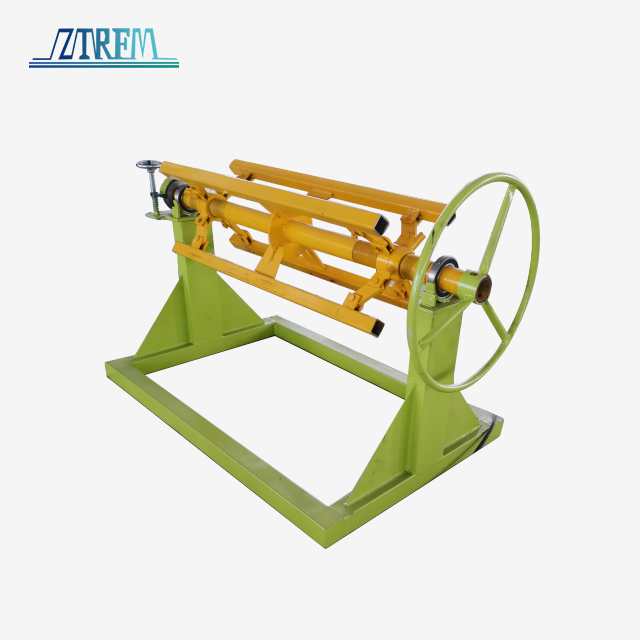
Hydraulic Decoiler - Heavy-Duty Metal Coil Uncoiling Solution
Cangzhou Zhongtuo Roll Forming Machinery Co., Ltd. presents its industrial-grade Hydraulic decoiler, engineered for seamless integration into high-capacity metal processing lines. This equipment handles coil weights ranging from 5 to 30 tons with precision hydraulic expansion mandrels. Our product accommodates coil widths from 200mm to 2000mm (customizable) and processes materials including PPGI, GI, and aluminum with thickness between 0.3-1.0mm. Powered by a 4kW hydraulic system and 5.5kW motor, it delivers stable unwinding speeds up to 40m/min. The pneumatic braking system ensures controlled deceleration, while the hydraulic press arm prevents coil loosening during operation.

What Is a Hydraulic Decoiler?
The product serves as a foundational component in metal coil processing systems. It holds, centers, and unwinds heavy master coils for downstream equipment.
Unlike mechanical alternatives, this machine uses high-pressure hydraulics to expand mandrel segments radially. This creates firm grip on the coil's inner diameter without surface damage.
The technology eliminates manual handling risks for loads exceeding 5 tons. It prevents material slippage during rapid line speed changes. Precise back-tension control stops telescoping, where coil layers shift sideways unexpectedly.
Your production line gains consistent material alignment. This ensures tight tolerances in roll forming, stamping, or slitting operations.

Technical Specifications
|
Parameter |
Specification |
|
Coil Material |
PPGI, GI, AI, SS |
|
Material Thickness |
0.3-1.0mm |
|
Coil Width Range |
200-2000mm (customized) |
|
Load Capacity |
5-30 tons |
|
Coil Inner Diameter |
480-520mm (standard); expandable with pads |
|
Expansion Mechanism |
Slider-type hydraulic push-pull |
|
Hydraulic Power |
4kW |
|
Motor Power |
5.5kW |
|
Forming Speed |
0-40m/min |
|
Braking System |
Pneumatic disc brake (adjustable force) |
|
Main Shaft Material |
40Cr forged steel, quenched & tempered |
|
Shaft Diameter |
190mm working face, 85mm through-hole |
|
Hydraulic Cylinder (expansion) |
FA-Φ125 × 130mm |
|
Hydraulic Cylinder (press arm) |
FA-Φ63 × 600mm |
|
Voltage |
380V 50Hz 3Phase |
|
Frame Construction |
Welded A3 steel with annealed bearing seats |
|
Surface Treatment |
Hard chrome plating on expansion drum |
Key Performance Features
Hydraulic Expansion System
The wedge-gliding expansion mechanism handles standard coil IDs (508mm, 610mm). It accommodates tolerance variations within 480-520mm range. This flexibility eliminates downtime when switching between suppliers' coils.
Advanced Drive Control
Vector Frequency Drives synchronize acceleration with your main production line. The system responds to loop sensors in milliseconds. Your material maintains optimal tension from start to finish.
Heavy-Duty Construction
The main shaft uses 40Cr forged steel with heat treatment. This design prevents deflection under cantilevered loads. Dual-row tapered roller bearings support weights up to 30 tons reliably.
Safety Integration
The hydraulic press arm contains outer coil layers during band cutting. This prevents dangerous spring-back when releasing high-tensile materials. Pneumatic braking delivers emergency stops within controlled rotation angles.

Industrial Applications
High-Speed Roll Forming Lines
Your roofing sheet or purlin production benefits from active-mode operation. Loop control sensors coordinate with the decoiler at speeds reaching 100 meters per minute. The system maintains profile consistency without introducing slack.
Precision Metal Stamping
Automotive press feed lines require surface-sensitive material handling. The hydraulic expansion leaves no deformation marks on exposed skin panels. Integrated back-tension assists straightener-feeder units in achieving flatness.
Heavy Gauge Processing
Slitting and cut-to-length lines handling materials up to 12mm thickness need robust uncoiling. The peel-off table and reinforced hold-down arm manage extreme tension. This prevents catastrophic clock-springing when cutting master coil bands.
Multi-Material Flexibility
You can process traditional PPGI steel or new composite materials. The adjustable tension system adapts to varying material yield strengths. This versatility matches Zhongtuo's multi-functional metal panel forming capabilities.
Quality Assurance Standards
Mandrel Concentricity Testing
Each expanded mandrel undergoes run-out measurement. We maintain tolerances below 0.2mm to ensure straight material feeding. Excessive run-out causes tracking issues in your downstream equipment.
Hydraulic Integrity Verification
All units pass 24-hour static pressure tests at 1.5x working pressure. Pilot-operated check valves mechanically lock pressure even during pump shutdowns. This prevents coil slippage from internal seal bypass.
Load Deflection Analysis
We test maximum rated weights on cantilevered shafts. Deflection measurements at the far end must meet industry minimums. This guarantees even uncoiling across your coil width.
Brake Performance Validation
Full-load emergency stop tests simulate real production scenarios. Braking torque verification ensures material pile-up prevention. Your line stops safely within specified rotation angles.
R&D-Backed Innovation
Zhongtuo collaborates with Yanshan University's National Cold Rolled Strip Equipment Engineering Research Center. Our Hydraulic decoiler benefits from finite element analysis and AI-assisted simulation.
PhD researchers optimize our mandrel expansion patterns. Virtual commissioning reduces trial costs during customization. Cloud-based remote monitoring enables predictive maintenance for your overseas installations.
This university-industry partnership has produced two patented technologies. These innovations enhance equipment stability and reduce operational complexity.
Why Choose Zhongtuo
As a national-level high-tech enterprise since 2022, we maintain ISO 9001, CE, and CAS certifications. Our equipment serves 150+ countries across Europe, North America, and Southeast Asia.
Strategic partnerships with Siemens and six universities ensure continuous technical advancement. Our factory-based graduate researchers implement AI-powered FEA optimization in production.
You receive customized solutions aligned with international standards and local preferences. Over a decade of export experience translates to reliable global support networks.
FAQ
Q: How do you handle coils with non-standard inner diameters?
A: We provide bolt-on auxiliary segments. These thickness pads convert 508mm mandrels to accommodate 610mm ID coils. You maintain secure gripping force without machine modifications.
Q: Why might the mandrel lose grip during operation?
A: Hydraulic check valve failure or worn cylinder seals cause internal bypass. Our pilot-operated valves prevent this mechanically. Regular seal inspections every 2,000 hours maintain pressure integrity.
Q: Is the hydraulic press arm necessary for all materials?
A: Materials thicker than 2mm or high-tensile steel require it. The arm safely contains potential energy during band cutting. It also guides the leading edge into straighteners.
Q: How does the machine synchronize with my production line?
A: Non-contact sonic sensors monitor material loop formation. This feedback adjusts VFD speed automatically. Your decoiler accelerates or decelerates based on downstream consumption rates.
Q: What maintenance schedule should we follow?
A: Replace hydraulic oil every 2,000 operation hours or annually. Clean suction filters monthly to prevent pump cavitation. Inspect hoses quarterly for wear or chafing damage.
Contact Us
Ready to optimize your metal coil processing line with the Hydraulic decoiler? Contact our engineering team at zhongtuorollforming@gmail.com for technical specifications and factory pricing.
_1750323743240.webp)