- English
- French
- German
- Portuguese
- Spanish
- Russian
- Japanese
- Korean
- Arabic
- Irish
- Greek
- Turkish
- Italian
- Danish
- Romanian
- Indonesian
- Czech
- Afrikaans
- Swedish
- Polish
- Basque
- Catalan
- Esperanto
- Hindi
- Lao
- Albanian
- Amharic
- Armenian
- Azerbaijani
- Belarusian
- Bengali
- Bosnian
- Bulgarian
- Cebuano
- Chichewa
- Corsican
- Croatian
- Dutch
- Estonian
- Filipino
- Finnish
- Frisian
- Galician
- Georgian
- Gujarati
- Haitian
- Hausa
- Hawaiian
- Hebrew
- Hmong
- Hungarian
- Icelandic
- Igbo
- Javanese
- Kannada
- Kazakh
- Khmer
- Kurdish
- Kyrgyz
- Latin
- Latvian
- Lithuanian
- Luxembou..
- Macedonian
- Malagasy
- Malay
- Malayalam
- Maltese
- Maori
- Marathi
- Mongolian
- Burmese
- Nepali
- Norwegian
- Pashto
- Persian
- Punjabi
- Serbian
- Sesotho
- Sinhala
- Slovak
- Slovenian
- Somali
- Samoan
- Scots Gaelic
- Shona
- Sindhi
- Sundanese
- Swahili
- Tajik
- Tamil
- Telugu
- Thai
- Ukrainian
- Urdu
- Uzbek
- Vietnamese
- Welsh
- Xhosa
- Yiddish
- Yoruba
- Zulu
sheet coil cutting machine
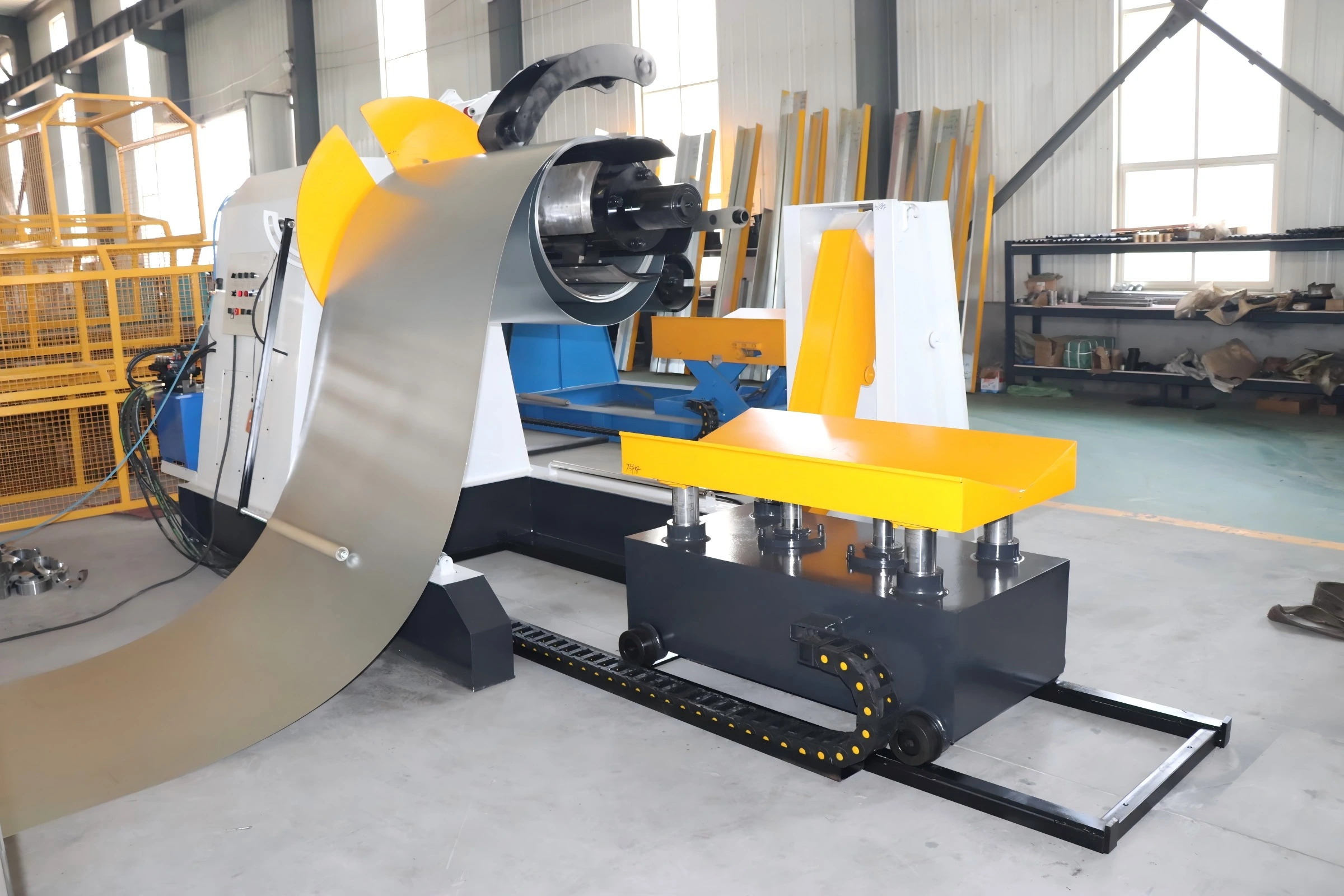
decoiler model taper
expand range 508mm/610mm/760mm 1
centring oil cylinder φ125mm,1100mm diameter 125mm, distance of run 1100mm
Sheet Coil Cutting Machine - Professional Metal Coil Processing Solution
Cangzhou Zhongtuo Roll Forming Machinery Co., Ltd. delivers industrial-grade sheet coil cutting machine systems engineered for high-precision metal processing. Our machines feature a 30-ton capacity taper decoiler with multi-diameter compatibility (508mm/610mm/760mm), equipped with a φ125mm oil cylinder offering 1100mm operational stroke for stable material feeding. Established in 2014 as a national-level high-tech enterprise, we combine over a decade of export expertise with ISO 9001, CE, and CAS certifications. Our cutting lines integrate 4-Hi precision levelers and hydraulic guillotine shears, delivering ±0.5mm diagonal accuracy while processing materials from 0.3mm aluminum to 10mm high-tensile steel.
What Makes a Professional Metal Coil Cutting Solution
Industrial metal fabrication demands equipment that transforms master coils into stress-free flat sheets. A professional cutting system eliminates coil set defects through multi-roll leveling technology while maintaining surface integrity.
Modern installations serve as the critical first step in manufacturing workflows. They convert raw coil stock into ready-to-fabricate blanks for stamping presses, laser cutters, and welding stations.
High-yield operations require automated length control and synchronized stacking. These features reduce material waste while preventing surface damage on sensitive substrates like pre-painted steel or mirror-finish stainless.
Technical Specifications of sheet coil cutting machine
|
Component |
Specification |
Your Benefit |
|
Decoiler Capacity |
30 Tons |
Handles large industrial coils without frequent changeovers |
|
Decoiler Model |
Taper Type |
Ensures stable coil unwinding and centering |
|
Expand Range |
508mm / 610mm / 760mm |
Accommodates multiple coil core sizes in your inventory |
|
Centering Oil Cylinder |
φ125mm diameter, 1100mm stroke |
Precise coil alignment for consistent material feed |
|
Length Tolerance |
±0.3mm |
Meets tight fabrication requirements for automated assembly |
|
Diagonal Accuracy |
±0.5mm |
Ensures squareness for welding and robotic handling |
|
Material Range |
200-1200 MPa tensile strength |
From soft aluminum to high-strength low-alloy steels |

Core Applications Across Industries
Automotive Component Manufacturing: Tier 1 suppliers process high-strength steel for chassis components and aluminum alloys for body panels. Tension-free leveling prevents post-stamping warpage, while vacuum stackers protect Class A surfaces.
Electrical Steel Processing: Transformer manufacturers require burr-free edges on grain-oriented silicon steel. Carbide blade systems maintain <0.02mm edge tolerances to preserve magnetic flux properties in core laminations.
Appliance Production: White goods manufacturers handle pre-coated metal and stainless steel for visible surfaces. PVC film applicators and synchronized conveyors protect aesthetic finishes throughout the cutting cycle.
Advanced Leveling Technology
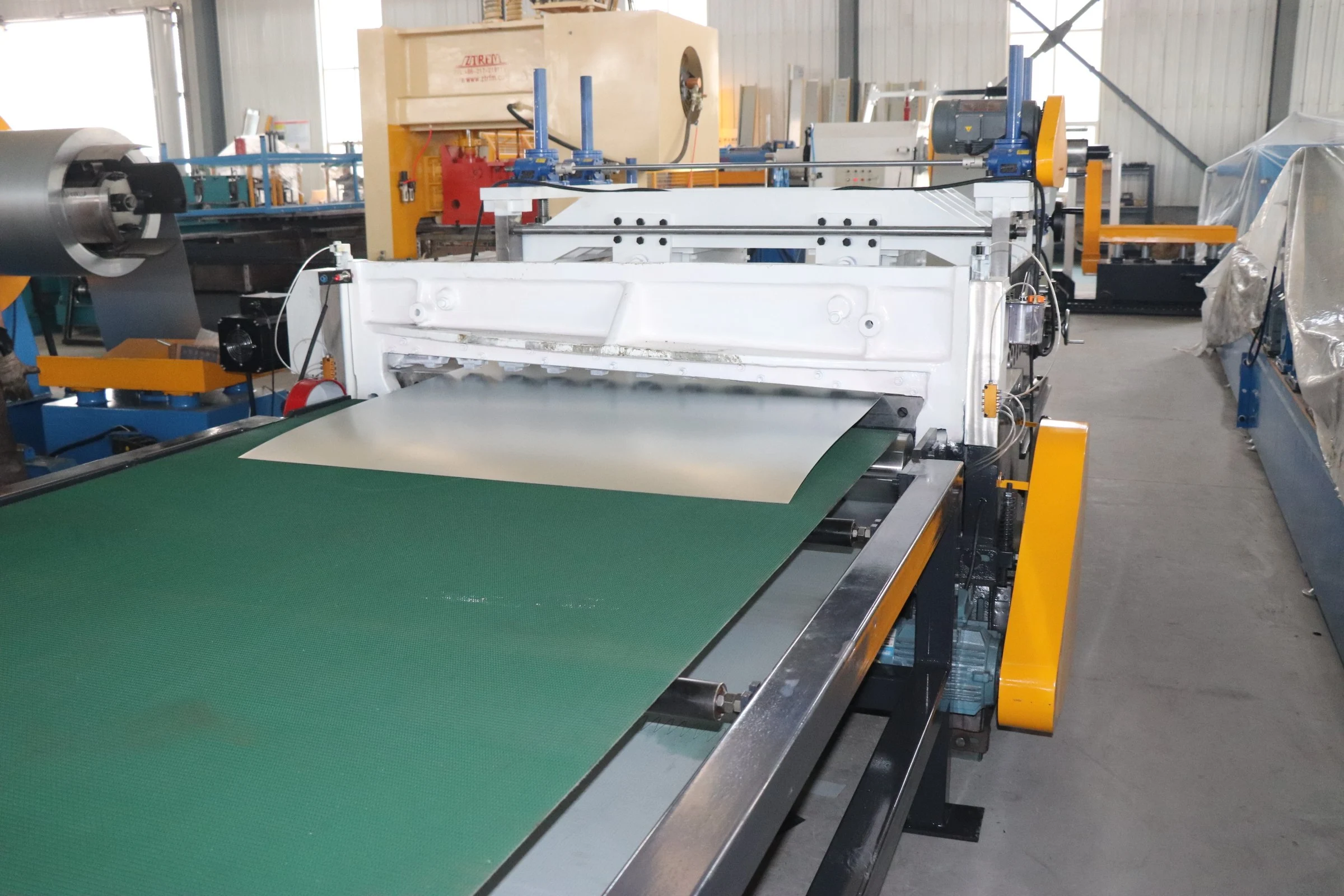
Precision leveling relies on hardened work rolls (HRC 58-62) arranged in 17-21 roll configurations. This design applies controlled bending cycles that neutralize internal stresses accumulated during coil winding.
The 4-Hi backup roll system provides independent edge and center adjustments. Operators can correct material waviness in real time without stopping production cycles.
High-tensile materials require greater roll pressure and smaller roller diameters. Our sheet coil cutting machine platforms accommodate cassette-style leveler exchanges for different thickness ranges, maintaining I-Unit flatness standards.
Shearing Systems and Blade Management
Hydraulic guillotine shears excel in heavy-gauge applications up to 25mm. The rigid blade holder design and servo-controlled gap adjustment ensure burr heights stay below 5% of material thickness.
Rotary flying shears enable continuous processing at speeds reaching 80 meters per minute. This configuration suits high-volume light-gauge production where stopping for each cut reduces throughput.
Blade materials like Cr12MoV or SKD11 extend service intervals to 20,000-40,000 cuts. Motorized auto-gap systems adjust clearance based on material properties, eliminating manual setup errors.

Quality Control Standards
Dimensional Verification: Laser interferometers validate cut lengths and diagonal squareness. Sheets meeting ±0.5mm diagonal tolerance ensure seamless robotic welding in downstream assembly.
Stress Relief Testing: Scribe tests on high-tensile stock confirm successful stress neutralization. Flat sheets after laser cutting prove the leveler eliminated internal tensions during processing.
Edge Quality Analysis: Microscopic burr height measurement validates shear rigidity and blade sharpness. Industry standards require burrs under 5% of material thickness for precision applications.
Surface Inspection: Visual checks detect roll marks or chatter patterns. Synchronized leveler rolls and proper lubrication maintain pristine surfaces on coated materials.
Smart Manufacturing Integration
Our R&D collaboration with Yanshan University's National Cold Rolled Strip Equipment Engineering Research Center brings intelligent automation to metal processing. AI-assisted finite element analysis optimizes roll patterns before production.
Virtual commissioning platforms enable remote debugging through Siemens cloud systems. Your operators receive equipment diagnostics and parameter adjustments without on-site service visits.
Predictive maintenance algorithms monitor vibration patterns and hydraulic pressures. The system alerts teams before component failures occur, maximizing uptime in 24/7 production environments.
FAQ
Q: Why do cut sheets show bowing or camber defects?
A: Uneven roll pressure or leveler misalignment causes this issue. Professional systems provide independent backup roll adjustments to correct center versus edge waviness during the leveling cycle.
Q: How should I set the correct shear blade gap?
A: Clearance depends on material thickness and tensile strength—typically 8-10% of thickness for mild steel. Motorized auto-gap systems prevent operator errors and reduce edge burrs significantly.
Q: Can one line process both 0.3mm and 10mm thickness?
A: Combination lines compromise quality. Thin gauge requires smaller roll diameters while thick materials need larger ones. We recommend separate leveler cassettes or dedicated machines for wide thickness ranges.
Q: How do you prevent scratches on mirror-finish stainless steel?
A: Equipment must feature polyurethane-coated pinch rolls, protective film applicators, and air-cushion stackers. These elements ensure sheets never slide against each other during handling cycles.
Q: What determines blade maintenance intervals?
A: Material abrasiveness affects blade life. High-silicon steel requires more frequent service than mild steel. Quality blade materials typically need rotation or regrinding every 20,000 to 40,000 cuts.
Contact Us
Ready to upgrade your metal processing capabilities with the sheet coil cutting machine? Contact us at zhongtuorollforming@gmail.com for technical consultation and quotation.


_1750323743240.webp)